
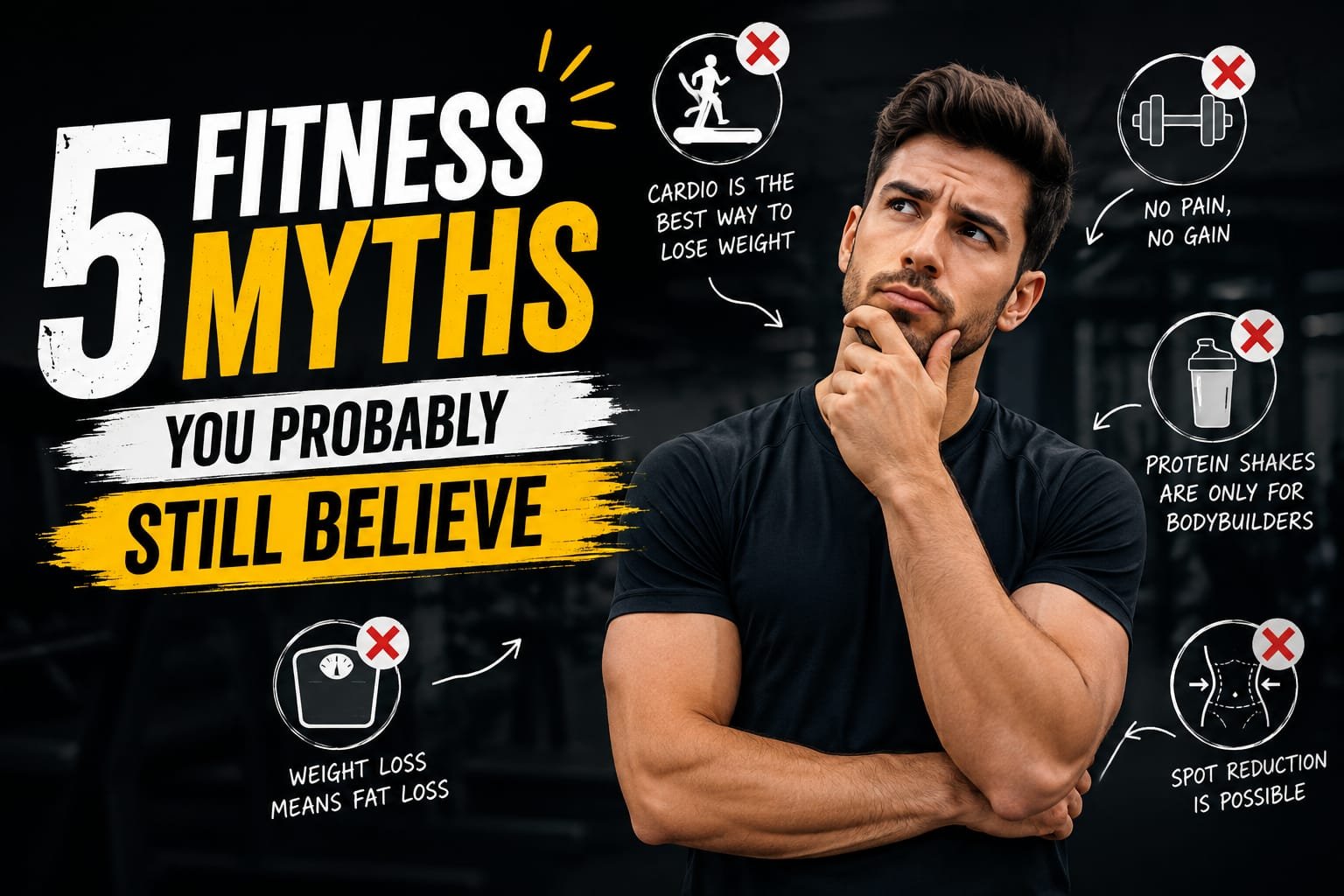
5 Fitness Myths You Probably Still Believe
Think sweating means you’re burning more fat? Believe you need to train every day to get results? You might be falling for some of the most common fitness myths.
Fitness advice is everywhere.
Social media is filled with workout hacks, “fat-burning” tricks, detoxes, supplements, and influencers promising faster results.
The problem?
Not everything that sounds scientific is actually true.
Some fitness myths have been around for decades and are repeated so often that they start to sound like facts.
Let’s clear up five of the most common ones.
—
Myth #1: More Sweat Means More Fat Burned
You’ve probably finished a workout drenched in sweat and thought:
“That must have been a great fat-burning workout.”
Not necessarily.
Sweating is primarily your body’s way of regulating temperature. When your body gets hot, sweat is produced and evaporation helps cool you down.
The amount you sweat can be influenced by:
– Temperature
– Humidity
– Genetics
– Clothing
– Hydration
– Exercise intensity
– Individual differences
Someone can sweat heavily during a relatively easy workout, while another person may barely sweat during a demanding session.
But what about the scale?
You might weigh less immediately after a very sweaty workout.
That’s mainly because you’ve lost water, not because you’ve suddenly lost a large amount of body fat.
Once you replace those fluids, your weight will generally move back toward its previous level.
The takeaway
Sweat is a cooling mechanism—not a fat-loss meter.
Don’t judge the quality of your workout by how soaked your T-shirt is.
—
Myth #2: You Need to Do Cardio to Lose Fat
Cardio is excellent for cardiovascular fitness, endurance, health, and increasing energy expenditure.
But it’s not the only way to support fat loss.
Resistance training can also contribute to fat-loss goals while helping you maintain or build muscle.
Your overall body composition is influenced by factors such as:
– Energy intake
– Physical activity
– Resistance training
– Protein intake
– Sleep
– Recovery
– Long-term consistency
Instead of thinking:
Cardio OR strength training
Think:
Cardio + strength training + nutrition + daily movement
The best approach depends on your goals, preferences, fitness level, and ability to stay consistent.
The takeaway
You don’t have to choose between cardio and strength training.
Use both strategically when appropriate.
—
Myth #3:
Lifting Weights Will Make Women “Bulky”
This is one of the most persistent myths in fitness.
Many women avoid resistance training because they’re worried that lifting weights will automatically make them extremely muscular.
That’s not how muscle growth works.
Building significant amounts of muscle generally requires consistent resistance training, adequate nutrition, recovery, and time.
For many people, resistance training can help improve:
– Muscle strength
– Bone health
– Physical function
– Athletic performance
– Body composition
– Confidence and independence
And no—lifting a dumbbell does not suddenly turn someone into a bodybuilder.
The takeaway
Strength training isn’t just for bodybuilders.
It’s a fundamental form of exercise for people of many ages and fitness levels.
—
Myth #4: You Can “Spot Reduce” Belly Fat
You’ve probably seen advertisements promising:
“Burn belly fat with this one exercise!”
Unfortunately, your body doesn’t work like that.
Doing hundreds of crunches can strengthen your abdominal muscles, but it doesn’t guarantee that the fat directly covering those muscles will disappear.
Fat loss occurs according to your body’s overall energy balance and individual physiology—not simply because you trained one particular body part.
You also can’t choose exactly where your body loses fat first.
Genetics, hormones, sex, age, and other factors influence fat distribution and where fat is lost.
So should you stop training your abs?
Absolutely not.
Abdominal exercises can improve:
– Trunk strength
– Muscular endurance
– Movement control
– Sports performance
– Overall core function
Just don’t expect 100 crunches to specifically melt abdominal fat.
The takeaway
Train the muscle you want to strengthen. Don’t expect to choose where your body loses fat.
—
Myth #5: No Pain, No Gain
This phrase sounds motivational.
But it’s also potentially misleading.
Exercise can be challenging. You may experience muscle fatigue, burning, or delayed-onset muscle soreness after an unfamiliar workout.
But pain is not a requirement for progress.
Sharp, severe, persistent, or unusual pain can be a warning sign that something needs attention.
A good training program should challenge you while still allowing appropriate recovery and progression.
Think:
Stimulus → Recovery → Adaptation
rather than:
Pain → More pain → Better results
You don’t need to destroy yourself every workout to make progress.
The takeaway
Train hard when appropriate—but train intelligently.
Progress comes from applying the right stimulus consistently and allowing your body to recover.
—
Bonus Myth:
You Need to Work Out Every Day
More exercise isn’t automatically better.
Your body needs recovery.
Training every day can work for some people if the intensity, volume, and type of activity are appropriately managed.
But you don’t need seven brutal workouts every week to become fitter.
For many people, a combination of:
– Strength training
– Cardiovascular exercise
– Walking or daily movement
– Mobility work
– Rest and recovery
can be far more sustainable.
The goal isn’t to do the most exercise possible.
The goal is to do the right amount consistently.
—
So What Should You Actually Believe?
Instead of chasing fitness hacks, focus on principles that have stood the test of time.
1. Consistency beats extremes
A sustainable routine performed for months is more valuable than a perfect routine you abandon after two weeks.
2. Progressive overload matters
Your body needs an appropriate challenge to adapt.
That could mean gradually increasing:
– Weight
– Repetitions
– Sets
– Training volume
– Exercise difficulty
– Movement quality
3. Recovery is part of training
Sleep, nutrition, rest days, and managing training load all contribute to your ability to adapt.
4. Nutrition matters
Exercise is important, but nutrition plays a major role in body composition and overall health.
5. Your program should match your goal
Training for:
– Fat loss
– Muscle growth
– Strength
– Running performance
– Sports
– Rehabilitation
– General health
will not necessarily look the same.
There is no single “best workout” for everyone.
—
The Bottom Line
Fitness doesn’t need to be complicated.
You don’t need to sweat buckets to burn fat.
You don’t need to do endless cardio.
Lifting weights won’t automatically make you bulky.
You can’t choose exactly where your body loses fat.
And pain isn’t a requirement for progress.
The most effective fitness strategy is usually much less exciting:
Train consistently. Eat appropriately. Recover well. Progress gradually.
Don’t let fitness myths distract you from the fundamentals.
Train smarter. Move better. Stay consistent.
That’s the foundation of Prehab101.
—
Frequently Asked Questions
Does sweating mean I’m burning fat?
No. Sweating primarily helps regulate body temperature. It isn’t a reliable indicator of how much fat you’re burning.
Is cardio necessary for fat loss?
No. Cardio can help increase energy expenditure and improve cardiovascular fitness, but resistance training and nutrition are also important components of a fat-loss strategy.
Can women lift heavy weights?
Yes. Resistance training can be highly beneficial for women, including improving strength, muscle function, bone health, and physical performance.
Can I lose belly fat by doing abdominal exercises?
Abdominal exercises can strengthen your abdominal muscles, but they cannot guarantee that fat will be lost specifically from your abdomen.
Is muscle soreness necessary for muscle growth?
No. Soreness can occur after training, particularly when introducing unfamiliar exercises or increasing training demands, but it isn’t a requirement for effective training.
Is it bad to exercise every day?
Not necessarily. It depends on the type, intensity, volume, recovery, and your individual goals. Daily movement can be healthy, but hard training every day isn’t necessary for everyone.
—
Final Thought
The fitness industry loves shortcuts.
But your body responds to fundamentals.
There is no magic exercise, no secret fat-burning zone, and no requirement to destroy yourself in the gym.
Build a program you can sustain, make gradual progress, and give your body enough time to recover.
Fitness isn’t about doing more. It’s about doing what works—and doing it consistently.
—
About Prehab101
Prehab101 is focused on helping people understand movement, injury prevention, rehabilitation, strength, and fitness through practical, evidence-informed content.